
New Gafcon structures announced but are Anglicans just too English?

Updated: Mar 7

Yesterday, Gafcon announced that, despite previous suggestions, they would not be electing a new primus inter pares to lead the majority of the world's Anglicans. Instead, the Most Revd Laurent Mbanda, Archbishop and Primate of the Province of the Anglican Church of Rwanda, was elected to chair the newly formed Global Anglican Council, which will in turn lead the Global Anglican Communion.
The initial response was muted. Many feared that once again orthodox Anglicans had been marched to the top of the hill, only to be marched back down again, (this is a reference to the 'Grand Old Duke of York', for readers not familiar with English nursery rhymes). It seemed that Gafcon's bark was worse than their bite and that the Archbishop of Canterbury had little to fear.
On reflection, this may not have been a fair analysis. It would appear that Gafcon are wrestling with the inherent Englishness of the Anglican expression of Christianity. That being an expression which relies less on the Roman code and papal decrees and more on good chaps (and chapesses) doing the right thing under the authority of Christ and His word alone. This means a Church where a quiet word should prevent disorder and the legal processes are the place of last resort.
Gafcon are very clear they are "reordering" the Anglican Communion. It is not a breakaway or even a takeover, as there is nothing to 'take over'. The Anglican Communion is, at heart, merely a set relationships between provinces, and between dioceses within provinces. It is in the diocese and province that episcopal and archepiscopal jurisdiction plays out, not the Communion.
As Gafcon look to the future they have perhaps unsuprisingly chosen a very 'English' approach. Gone is the quasi-papal figurehead, the 'first among equals', to whom all are meant to look for spiritual wisdom and functional leadership.
The experience of the past thirty years has shown just how ineffective such a figurehead can be. Time and again, individual provinces have chosen to reject the authority of Scripture and go their own way, while at the same time demanding to be considered 'faithful Anglicans'. In response consecutive 'figureheads' have failed to exert the only discipline available to them - the breaking of relationships and thus the effective exclusion of provinces from the Communion.
So, Gafcon have chosen to have a Council instead of a figurehead. It will be concilliar in nature, with lay people, clergy and bishops serving for five year terms. The Chair will be given an honoured place but membership of the Global Anglican Communion will not focus on a province's relationship with them as an individual. Rather, it will be based on the willingness of individuals, dioceses or provinces, to give their assent, without reservation, to the Jerusalem Declaration (JD).
In the light of the 'Englishness' otherwise adopted it is therefore somewhat ironic that by so doing they have implicitly rejected another typically English trait. As seen in the toleration in high office for so long of a certain Peter Mandelson, the English do not tend to like imputing guilt by association.
However, in making the crunch issue not a choice of one leader or another, but with whom to be in visible partnership, that inevitably means electing one association or the other. In what has turned out to be a remarkable week, albeit, in unforeseen ways, that such is the decision has become extremely clear.
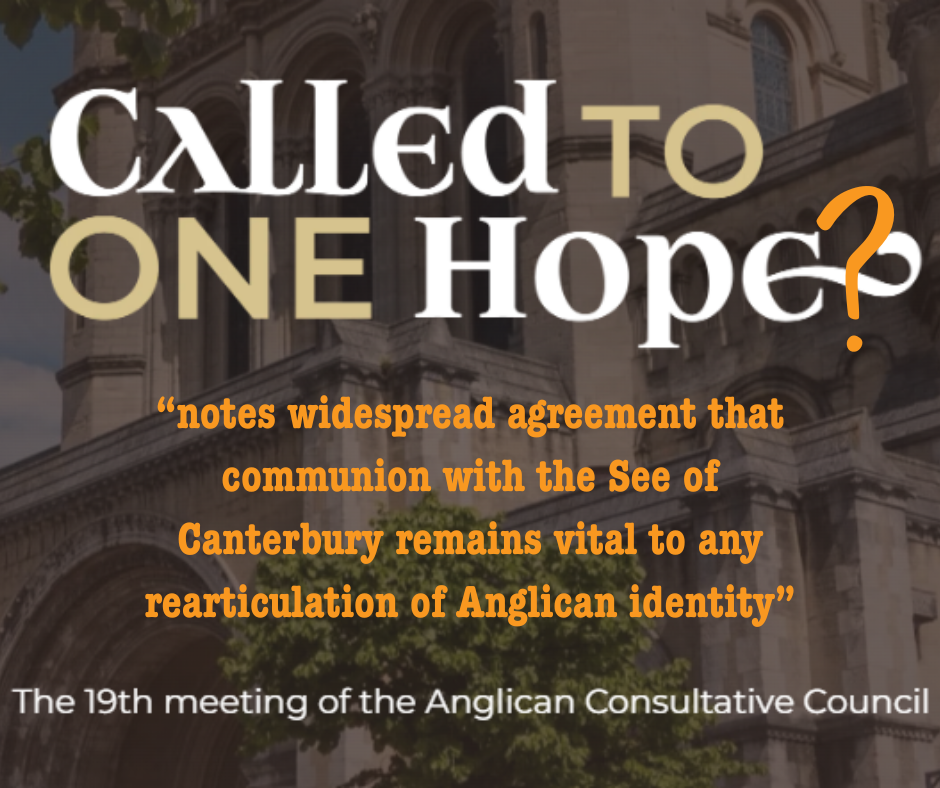
On the one hand is the Anglican Consultative Council tying themselves in knots to describe what in essence is merely an appeal to institutional unity, on the other, Gafcon offers true association on the basis of a simple confession of faith. It is a choice between two definitions of Communion of wholly different gospel worth.
In doing this, Gafcon will have to trust that those signing the JD do so in good faith. And there will need to be a transparent and robust disciplinary process for those who reject, or fail to live out, any of its tenets. Although JD-affirming individuals will doubtless, always be welcome in the Global Anglican Communion, hard decisions will be required.
In particular, given the clear choice outlined above, Gafcon will need to decide swiftly whether it could even be contemplated for clergy and laity who elect to continue to serve in non-JD affirming dioceses or provinces to serve on the Council. It would seem unlikely for that to be possible, given the conflicts it would involve, and that is just the type of clear discipline that will be needed.
Archbishop Mbanda told the Pastor's Heart, the future of the Global Anglican Communion, "is not going to be about geography, but theology." But he went on to warn that theology alone will not be enough, "I don't think the Instruments of the Anglican Communion failed. I think what failed is the leadership to bring discipline - to use those Instruments to serve the purpose for which they were created."
The Global Anglican Communion has arrived. It is a beautiful day. But that beauty will depend on how effective the Council proves to be when it comes to the difficult task of church discipline - something at which the English have sadly spectacularly failed!
Anglican Futures offers more than a blog
Join us online to discuss the events and implications of G26
Thursday 12th March 7.30pm


Comments