
"Choose This Day”: Abuja and the Future of Anglicanism Beyond Canterbury

Updated: Mar 26
As bishops, clergy, and delegates processed into the sanctuary in Abuja for the Opening Eucharist of G26, the congregation rose to sing Stand Up for Jesus. The hymn was familiar to many, but in this setting it carried unusual weight. It felt less like routine liturgy and more like a declaration of intent. The Global Anglican Communion has arrived at a moment of decision, and the language of allegiance is no longer theoretical.
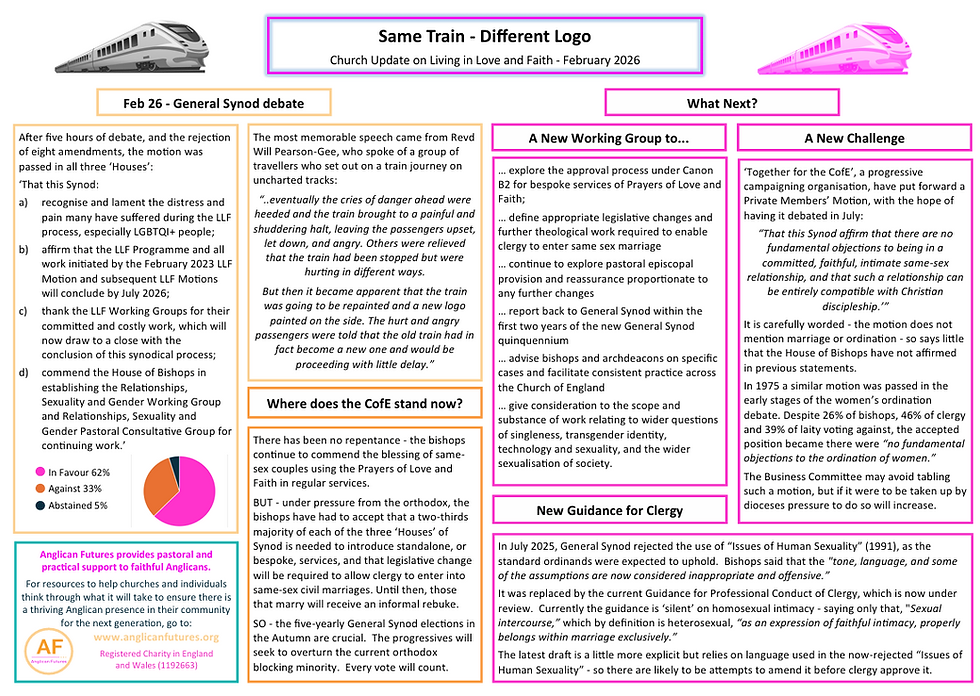
This 2026 gathering is not one of the regular five-year GAFCON assemblies. It is a council of bishops and primates convened to consider the future shape of global Anglicanism in light of recent developments within the Church of England and the wider Communion. Structures which have historically centered on the Archbishop of Canterbury. For years, questions of authority, doctrine, and communion have simmered beneath the surface of this global fellowship. With the appointment of Archbishop Sarah Mullally as Archbishop of Canterbury, and with the continuing trajectory of Living in Love and Faith (LLF), those questions are now unavoidable. Though LLF has been re-badged, there are no real illusions that the CoE is ready to backtrack on their revisionist trajectory.
The Scripture readings framed the day with striking clarity. Joshua 24 recounted the faithfulness of God to Israel and Joshua’s decisive words, “As for me and my house, we will serve the Lord.” The Epistle from 2 Corinthians warned against being unequally yoked, and the Gospel from Matthew 6 reminded the congregation that one cannot serve both God and mammon. Together, they set before the assembly a stark contrast between divided allegiance and covenant fidelity.
Archbishop Henry Ndukuba, Primate of the Church of Nigeria, preached from Joshua. He emphasized that the promised land was not an empty inheritance but territory already occupied by rival nations and rival loyalties. Israel’s task was not to blend with surrounding cultures but to remain faithful to the Lord who had redeemed them. Victory, he said, comes through trust in God and obedience to his Word.
Joshua’s closing appeal, the Archbishop noted, contained several elements: a call to decision, a renunciation of other gods, an urgency about choosing whom to serve, an imperative of wholehearted devotion, and a commitment that encompassed one’s household. Joshua did not merely speak for himself. He claimed his family within the covenant and summoned the nation to do the same. The sermon also addressed contemporary distortions.
Revisionist ideologies within parts of the Western Church were named. So too was the prosperity gospel that has taken hold in some contexts, reducing faith to material gain. Though these errors differ in tone and origin, both ultimately redirect loyalty away from Christ. Both press the Church to serve something other than the Lord.
The Eucharist that followed grounded the gathering in a deeper unity. Before governance structures were debated or refined, the assembly knelt together at the Table of the Lord. Word and Sacrament reminded all present that the Church’s communion begins not in Canterbury, Kigali, or Abuja, but in Christ himself.
For Anglicans in England, this moment is inevitably complex. The Church of England has long been regarded as the mother Church of the Anglican Communion. For centuries, the Archbishop of Canterbury functioned as the personal focus of unity among the Instruments of Communion. The Lambeth Conference, the Primates’ Meetings, and the Anglican Consultative Council were convened in relation to that historic center. Yet the last two decades have revealed deep theological fractures. Decisions concerning human sexuality, the authority of Scripture, and the nature of marriage placed Canterbury increasingly at odds with the majority of Anglicans worldwide, particularly in Africa, Asia, and Latin America. Repeated warnings from Global South primates have not reversed that trajectory. The development of Living in Love and Faith (and accompanying ideological documents and teachings), and the election of an Archbishop who has publicly supported such developments, have only intensified the divide.
For many in the Global South, this is not experienced as a rebellion against England, but as a response to England’s departure from shared doctrinal commitments. Archbishop Ndukuba underscored this point by recalling Article 19 of the Thirty-Nine Articles of Religion, which acknowledges that even ancient churches have erred in matters of faith. He added, with evident sobriety, that this principle applies equally to the Church of England. The implication was not triumphal but cautionary: no church is immune from doctrinal drift.
What is unfolding in Abuja, therefore, is not a sudden rupture, but the culmination of a long process of differentiation. GAFCON has consistently maintained that it did not leave the Anglican Communion but sought to uphold its historic faith when other provinces departed from it. The forthcoming election of a Chairman to serve as primus inter pares among the Global Primates Council reflects a conviction that global Anglican leadership can no longer be tied exclusively to Canterbury.
For English Anglicans who remain committed to biblical orthodoxy, this is a bittersweet moment. It involves grief over what was lost and uncertainty about what lies ahead. Yet it also brings clarity. The centre of gravity within global Anglicanism has shifted decisively toward provinces that represent the majority of practicing Anglicans and that remain committed to the authority of Scripture and the historic formularies.
The hymn that opened the service therefore resonates beyond Nigeria. “Stand up for Jesus” is not a slogan of cultural aggression but a call to covenant fidelity. It challenges leaders and congregations alike to examine where their ultimate loyalty lies. Joshua’s ancient question reverberates in contemporary form: whom will we serve?
As G26 proceeds, many are watching to see how this clarity will be translated into durable structures of communion and mutual accountability. For Anglicans in England, the developments in Abuja may feel distant geographically, yet they bear directly upon the future of Anglican identity worldwide. This is a moment for sober reflection rather than triumph or resentment. The history of the Church reminds us that renewal often arises from seasons of crisis. If Article 19 teaches that churches may err, it also implies that repentance and reform remain possible. Whether in England, Africa, or elsewhere, the path forward begins not with institutional realignment alone but with renewed obedience to Christ.
In Abuja, the call was set before the global Church once more: Choose this day whom you will serve. That summons now echoes from Nigeria back to England. The response will shape the next chapter of Anglican history both in the UK and around the world.
Anglican Futures offers more than a blog
Join us online to discuss the events and implications of G26
Thursday 12th March 7.30pm


Comments